Recent Home Movers: The Highest-Intent Audience You're Not Targeting
Moving costs UK households almost £18,000 and resets what they buy. How to find recent home movers and reach them before the window closes.

In short
Moving home is the biggest discretionary spending event in a UK household's life, and it has an end date. The cost of moving in England now averages £17,831 (reallymoving, Nov 2025), and HMRC recorded 96,330 residential property transactions in December 2024 alone, up 19% year on year. That is a rolling supply of households replacing furniture, appliances, insurance and utilities within weeks of completion. Meta and Klaviyo have no reliable signal for it. A move stage appended to your customer file does, which is why "just moved" audiences beat generic prospecting in any home-anchored category.
The homemover opportunity
The scale first. HMRC's monthly property transaction statistics recorded 96,330 residential transactions in December 2024, 19% up on the same month a year earlier (HMRC). That is roughly one month's worth of households simultaneously re-buying most of their home.
And moving is expensive in a way that reveals intent:
| Figure | What it measures | Source |
|---|---|---|
| £17,831 | Average cost of moving in England, from quotes by 181,000 home movers | reallymoving Cost of Moving Report, Nov 2025 |
| Almost £18,000 | Cost of moving house, consumer survey | Which?, Nov 2025 |
| Almost £14,000 | Same measure, one year earlier — showing the trend | Which?, Nov 2024 |
| 96,330 | UK residential property transactions, Dec 2024 (+19% YoY) | HMRC |
Those totals cover stamp duty, legal and agency fees rather than retail spend, so treat them as evidence of a household in transaction mode, not as an addressable basket. The point for a marketer is the behaviour around a number that size. A household spending £18,000 to move is also replacing the sofa, the washing machine, the broadband and the insurance, inside a few weeks.
This is not incremental demand. It is a reset of what the household buys, and unlike an interest signal it expires.
What home movers buy
More categories are affected by a move than most brands assume.
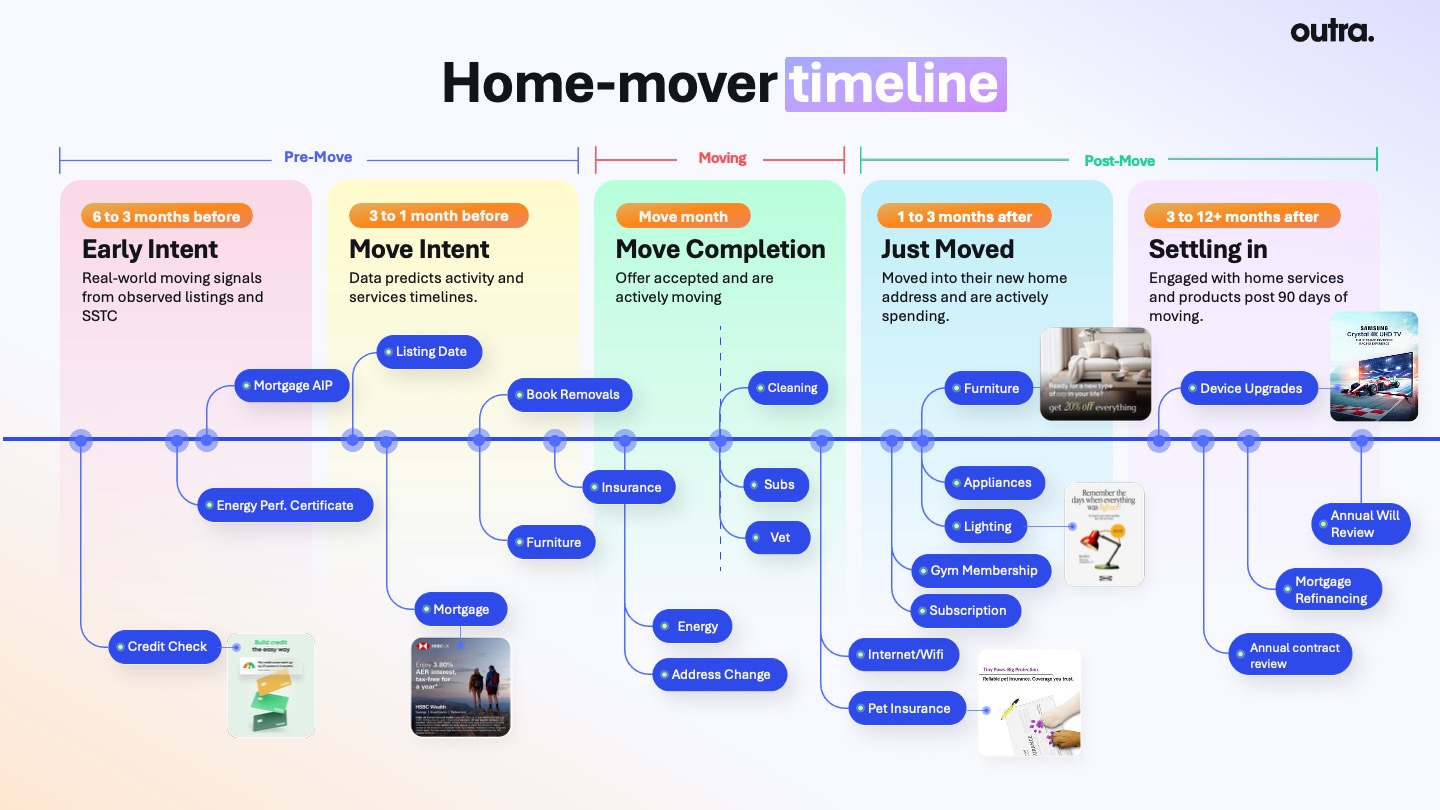
Early Intent (6 to 3 months before)
Real-world moving signals from observed listings and SSTC.
- Credit check
- Energy performance certificate
- Mortgage AIP
Move Intent (3 to 1 month before)
Data predicts activity and services timelines.
- Listing date
- Mortgage
- Book removals
- Insurance
- Furniture
Move Completion (move month)
Offer accepted and actively moving.
- Energy
- Address change
- Cleaning
- Subscriptions
- Vet
Just Moved (1 to 3 months after)
Moved into the new address and actively spending.
- Furniture
- Appliances
- Lighting
- Gym membership
- Subscriptions
- Internet and WiFi
- Pet insurance
Settling In (3 to 12+ months after)
Engaged with home services and products past 90 days from the move.
- Device upgrades
- Annual will review
- Mortgage refinancing
- Annual contract review
The window is short
Spending is not spread evenly across the move. It spikes and then decays.
- One to three months before. Researching, comparing, not buying yet.
- Move week. Essentials only. Nobody is browsing.
- Month one. The heaviest spend. Whatever is missing gets bought.
- Months two and three. Considered purchases, filling gaps.
- Months four to six. Lifestyle purchases as the house settles.
- Months six to twelve. Back towards normal, still above baseline.
So reach them early. By month six most of the money has already been spent, usually with whoever showed up first.
Home mover data: how you actually find them
Ad platforms do not know who has just moved. Home mover data does: property listings, sold subject to contract flags, completion records and occupancy changes, matched to a household address. That is the raw material. What matters is how you use it.
Enrich the customers you already have
Send Outra your customer or CRM file. We match it at household level and append a move stage, so you can see which of your existing customers are pre-move, in the move month, or three months in. That feeds a Klaviyo flow or a suppression list without you buying a single new impression.
Prospect the movers who are not yours yet
Outra builds an audience of UK households at a chosen move stage, filtered by property type, value, location or anything else that matters to your category, and suppresses your existing customers so you are not paying to reach them twice. That audience syncs to Meta, Google, TikTok and Klaviyo as a named audience, and refreshes daily as new households enter and leave the window.
Run both
Most brands end up here. Email the movers already in your database, prospect the ones who are not, and use the same move-stage definition for both so your reporting compares like with like.
What to run once you have the audience
Meta and Instagram
Push the mover audience in as a Custom Audience and let it refresh daily, so the people in it are always inside the window. Suppress existing customers unless the campaign is a cross-sell. Creative should show the product in a new home rather than talking about moving, which people tire of quickly.
Use the same audience for Customer Match, then bid up on movers in the categories where the move creates the demand. Search copy that names the situation, for example a new address or a first week in the house, tends to hold its click-through rate longer than generic offers.
Klaviyo
Trigger a flow when a subscriber is flagged as a mover, send the products that match their stage, and raise frequency for the first month only. Drop back afterwards. The stage attribute tells you when to stop, which is the part most mover campaigns get wrong.
Why movers are worth more later
Customers acquired during a move usually pay back better than the CAC alone suggests. The first basket is larger because they are filling a house. They buy across categories they would not normally consider, so the second and third orders come faster. Habits formed during a move tend to stick, which shows up in repeat rate rather than in the first conversion. And movers talk to other movers.
Worth measuring properly. If you only judge a mover campaign on first-order ROAS, you will underprice it.
Where to start
Recent home movers are the highest-intent audience most brands never build. They are replacing things, they have a budget for it, and the window closes.
Two practical starting points: append move stage to your customer file and see how many are already in the window, or build a prospecting audience of movers who are not customers yet and test it against your current best-performing audience. Outra does both, and the same move-stage definition carries across Meta, Google, TikTok and Klaviyo so the numbers line up.
Read next: the practical playbook for targeting a specific audience on Facebook ads, and how this changes what targeted Facebook ads cost.
Activate Just moved, Recently Moved and Predicted Move households
Outra's Move stage attribute powers ready-made segments, Move intent, Moving, Just moved, Recently Moved, Sale anniversaries, for mover-specific creative on Meta, Google and Klaviyo.
What Outra knows about every UK household
All attributes and segments are tied to a single identifier: the household, not an email, not a cookie.
- Employment stage
- Move stage
- Age band
- Family stage
- Occupancy status
- Property type
- Bedrooms
- Property size
- Property value band (£)
- Garden
- Garage
- Parking / Driveway
- Area type
- Region
- Purchasing power band
- Household income band
- Credit score band
- UHW (ultra-high wealth)